Cameras — cameras.html
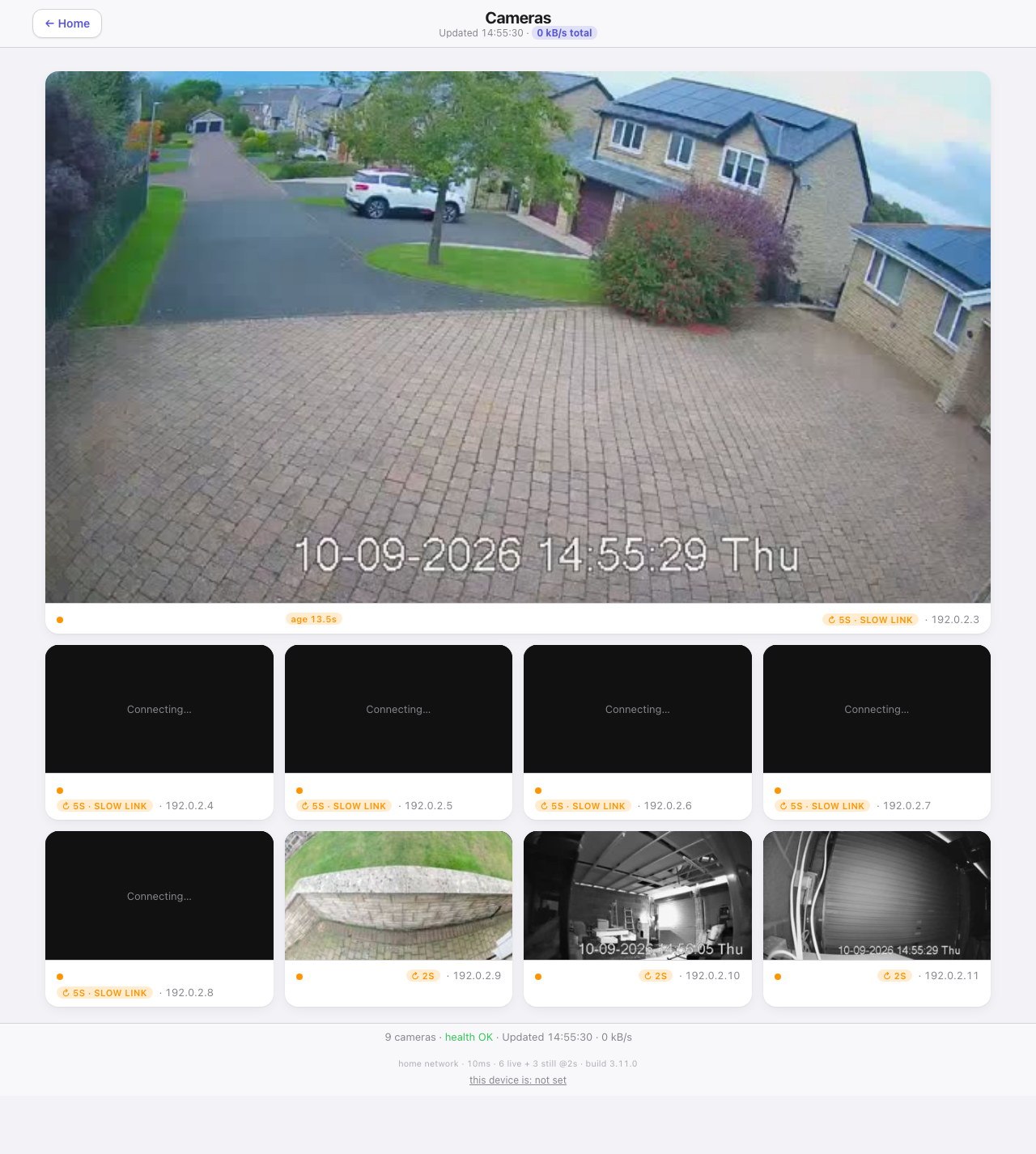
One large tile and a grid of the rest, each either streaming live or polling a still, depending on how the page was reached and how fast the link is. The mechanics — go2rtc, ffmpeg, the proxy on port 8177 — are on the Cameras page; this is what the page itself does.
Down the page
Header. Title, last update, and a live bandwidth figure in kB/s for the whole page. That figure is the point of the header: this is the one page that can saturate a mobile connection.
Main tile. The first camera marked “main” in the configuration, at full width, with the camera’s own timestamp overlay. The strip under it carries a state dot, the age of the current frame, the mode badge and the camera’s address.
Grid. The remaining cameras, four across, each with the same strip.
Footer. Camera count, last update, total bandwidth, a health word, then a second line giving the detected connection (“home network”), the measured link, the live-versus-still split, and the build number. Under that, a link reading “this device is: not set” — tapping it pins how this particular browser should behave rather than leaving it to detection.
Modes
Each tile shows one of these as a badge:
- live — a continuous MJPEG stream.
- 2s, 5s — polling the still image at that interval. A slow link gets the longer one, and the badge says “SLOW LINK” when the page has decided that for itself.
The page assumes it is remote until it can prove otherwise. Away from home the tiles poll rather than stream, and the away path uses WebRTC for the one tile that stays live. The state dot has four states: grey before anything has arrived, green with live frames, amber when connected but frames have stalled, red when unreachable. A tile that cannot get a still says so on the tile itself (“No snapshot (HTTP 404)”) rather than staying a blank square.
Where the pictures come from
The plugin’s own port 8177, not the web server: /mjpeg/<host> for a stream, cam-<host>.jpg for a still. Camera hosts, vendors, stream names and room membership all come from the configuration; changing them needs a plugin restart. The state dots come from Indigo’s /v2/api.
Refresh
The page ticks every second for its own status line. The pictures refresh at each tile’s own rate: continuously when live, every 2 or 5 seconds when polling. Reached through the reflector, it polls at a tenth of the home rate, and after ten minutes with nobody touching it everything stops until you tap.
What you can do here
- Tap a tile to promote it to the main position, and tap the main tile for full screen.
- Pin this device’s mode with the “this device is” link.
- Jump to Settings to change the camera configuration.
Worth knowing
- The number of tiles that can be live at once is a browser limit (
livePoolSize, default six), not a plugin one. - A sub-second stream failure with a 500 is usually ffmpeg’s first attempt; one retry clears it.
- All the cameras at full rate can be tens of megabits a second, which is why the bandwidth figure is in the header rather than buried in a fold.