Meter — meter.html?id=N
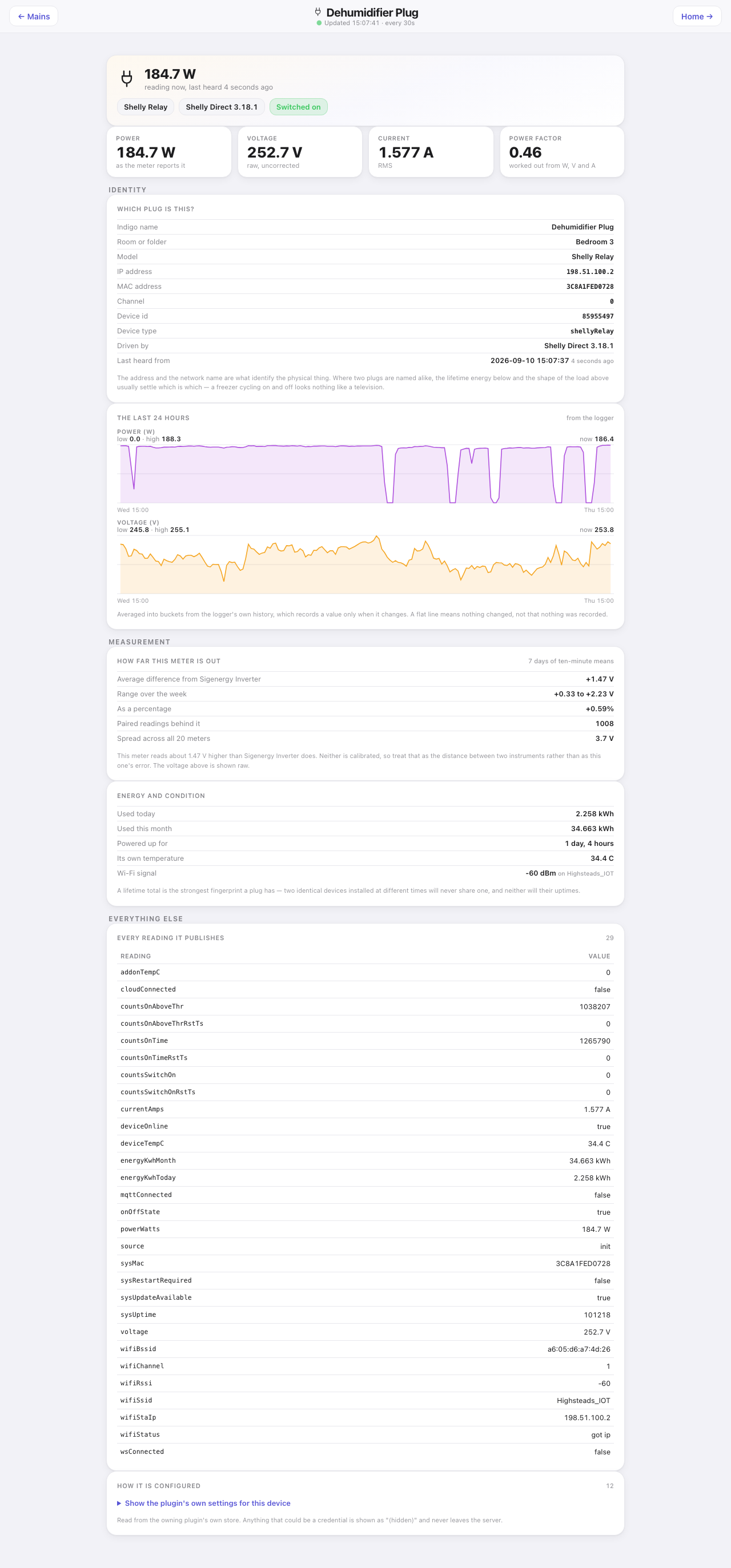
The drill-down from Mains. Which meter it shows comes from the query string, and the id is the Indigo device id:
meter.html?id=123456
It exists because two identically named plugs can sit on a census with nothing saying which is which — so this page leads with the things that identify a physical device, not just a reading. Read-only throughout.
Down the page
Hero. The name, live power in large type, and how long ago it was last heard from. A meter that is not answering shows a dash here and moves its last reading into the sub-line as history.
Live tiles. Power, voltage (raw, uncorrected), current and power factor — the last marked “worked out from W, V and A” when the meter does not report it directly.
Identity. Which device this actually is: Indigo name, room, model, address, channel, device id, device type, driving plugin and version, and when it last spoke. Two identically named devices never share an address or an uptime.
Position. Where this meter sits on a scale of every live meter in the house, with its rank. Only drawn for a meter that is answering — a frozen reading cannot be placed on a scale of live ones.
The last 24 hours. Two charts from the SQL Logger history — power and voltage — each with its low, high and current value. The note says plainly that a flat line means nothing changed, not that nothing was recorded.
How far this meter is out. Its average difference from the reference, the range over the week, that difference as a percentage, how many paired readings back it, and the spread across every meter in the house. Neither instrument is calibrated, so this is a distance between two readings, not an error.
Energy and condition. Used today, used this month, how long it has been powered, its own temperature, and its Wi-Fi signal — whichever of those the device reports.
Everything else. Every raw reading the device publishes, as a table. The whole of what the plugin knows about the device, not a curated subset.
How it is configured. A collapsed panel showing the owning plugin’s own stored settings for this device, with anything that looks like a credential shown as “(hidden)”.
Where the numbers come from
mainsMeter: live tiles and identity from the Indigo device’s own state; the charts and the week’s offset from the SQL Logger history, PK-ranged so a heavy query cannot stall the server.
Refresh
Every 30 s. Identical output writes nothing to the page, so a fold you have opened stays open.
What you can do here
Nothing — read only. Follow “Mains” back to the full census.
Worth knowing
- A lifetime energy total and an uptime are the two figures that can never coincidentally match between two otherwise identical devices — use them, not the wattage, to tell two plugs apart.
- Every value on a dead meter is dashed together. Guarding the headline of a reading is not guarding the reading: a plug with no mains cannot be measuring 250 V, whatever its last state says.